
Fair Park is an urban treasure for Art Deco architecture in the US. It is home to the largest collection of Art Deco exhibition buildings and was part of the City Beautiful projects of the era.
Visitors to Dallas who love architecture, history, and beautiful outdoor spaces, should put Fair Park at the top of their list. While Miami may boast the largest collection of Art Deco architecture in the world, Fair Park holds the largest collection of 1930s Art Deco exposition-style architecture in the United States, spread across 277 acres of beautifully landscaped grounds.
An urban treasure, Fair Park stands as the only intact and unaltered pre-1950s world fair site in the United States. In a CBS News feature, Fair Park is described as one of the finest examples of city planning and beautification of a public space to be found anywhere in the world.
The Esplanade at Fair Park

The Hall of State as seen from the west end of the Esplanade and reflecting pool.
Fair Park is of significant historical value because it was the site of the 1936 Texas Centennial, and the State Fair of Texas has been held there every year for over 100 years.
At 277 acres, the park is massive. For the purpose of this photo essay, I’m focusing on the sculpture and historic buildings along the Esplanade, the real gem of the park.
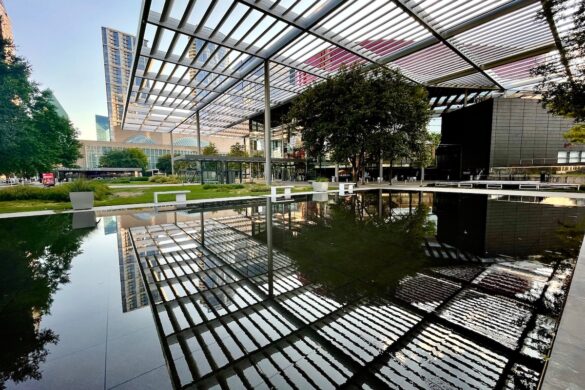
Built especially for the Centennial, the Esplanade features a 700-foot reflection pool and three fountains. During the State Fair of Texas and other special events, there are water shows set to music and lit by more than 170 lights. To me, this is the real gem of the park, though there are other interesting structures to explore.

The fountains and reflecting pool at the Esplanade at Fair Park.
Everything is bigger in Texas
The reflection pool is flanked on each side by Art Deco buildings, each with three huge porticos. The architect behind the design, George Dahl, described the style as “Texanic.” Fabulous larger-than-life sculptures depict the six flags of the nations that flew over Texas: Mexico, The Confederacy, Spain, France, The Republic of Texas, and the United States. The feeling of expansiveness, very much a part of the ambiance of the state of Texas, is well represented in these sculptures.

Statue representing Texas as part of Spain.

Close up Texas under the rule of Spain
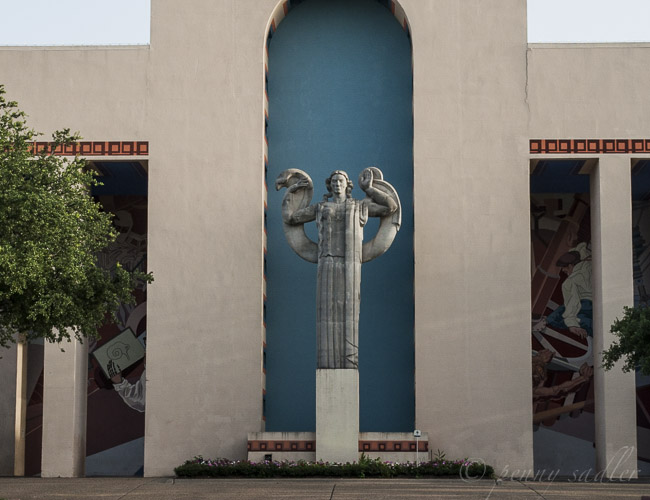
Statue representing Mexico.
Spain ruled Texas for 105 years from 1716-1821. After the Spanish left, Mexico ruled for 115 years. The battle at the Alamo in San Antonio was the beginning of the end of Mexican rule in the state.

Close up, Texas under Mexico.
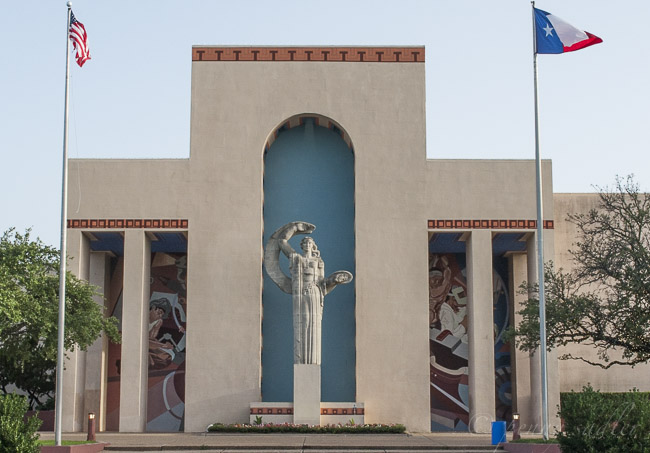
Texas as part of France bearing grapes.
The French never had a strong hold on Texas, though they tried.
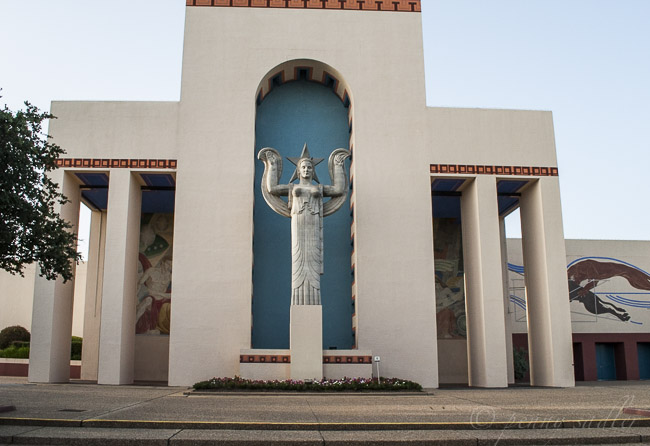
Statue of Texas under the Republic of Texas with Lone Star and Cotton flower.
Texas gained independence from Mexico in 1836. One year later it was recognized as a republic by the United States.

Statue of Texas as part of the Confederacy.

Close up, Texas under the Confederacy.
On December 29, 1845, Texas became the 28th state of the Union. The transfer of the government was official on February 19, 1946.

Texas joins the United States of America.
The Texas Centennial
For the Texas Centennial, a team of international, national, and regional artists including several winners of the prestigious Prix de Rome, assembled in 1936 to augment the Art Deco architecture with murals and bas relief work.

Bas relief mural by Pierre Bourdelle.
The Hall Of State
A walk along the Esplanade should begin at the west entrance on Parry Ave. and culminate at the elaborate Hall of State. Built in 1936 to commemorate the Texas Centennial, the Hall of State is considered the “crown jewel” of the Centennial and is dedicated to four centuries of Texas history, economic, agricultural, and social achievement under the flags of six nations.
In 1938, the Dallas Historical Society took custody and assumed responsibility for operating it as a Museum of History and research center, holding a collection of artifacts and archives in excess of three million pieces.
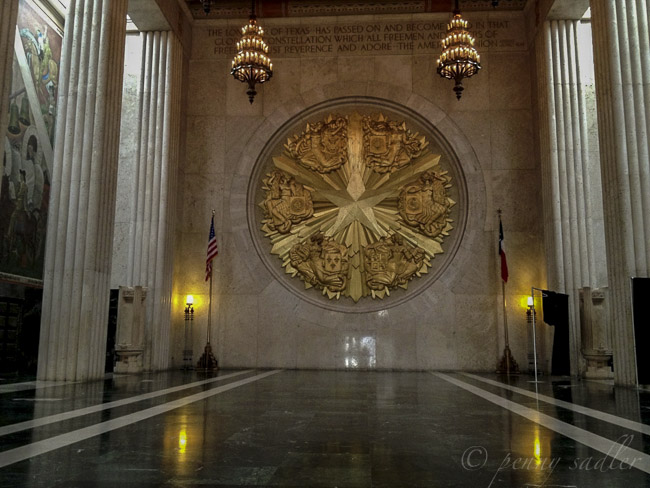
Interior Hall of State, Fair Park, Dallas.

Exterior of The Hall of State
Fair Park is a fantastic place for a walk and a brief history lesson. It’s now on my list of not to be not to be missed attractions in Dallas.
Have you been to Fair Park?




33 comments
Yes the artwork, design and architectural details are magnificent to visit even on a very cold night that you took me there to see these wonderful buildings.
Noel, I’m glad you got to see it. There will be a lot of changes coming there we hope for the best!
Oh this is just marvelous! I love the way you bring the reader right into your exploration of the park, next time I am in Dallas, I intend to visit this park.
If you ever make it to Milwaukee you may want to consider staying at, The Ambassador Hotel, it is an exquisite deco era hotel that was refurbished. I was fortunate enough to have been put up there while visiting for work, but even if you didn’t stay there it is worth skipping into the lobby.
Thanks for the tip!
wow, how stunning is this, glad they were able to preserve these buildings and details – gorgeous
It is really cool!
Fair Park looks like a great place to take a break from the city. Thanks for sharing!
It is and the crazy part – it’s in the city!
Very intriguing!
Art Deco isn’t the first thing that pops into my head when I think of Dallas, but Fair Park looks and sounds terrific. What a gorgeous splash of history!
IKR. It is a really lovely place. Being further developed. In the next ten years it will be a different place. All the art deco will still be there of course, but accessibility will change. If you get a chance to come to Dallas it should be seen now.
What a pleasant surprise! Love how it is described at “Texanic!” Looks very impressive. Thanks for sharing 🙂
“Texanic” is a great word.
What a nice surprise! I never would have thought to look for art deco architecture in in Dallas, Texas!
It does seem counter intuitive. Fair Park is exceptional.
What a spectacular art deco site! The Esplanade at Fair Park would certainly would be at the top of my list of things to see in Dallas.
You would love it! I will follow up with more photos after the State Fair clears out. For the next few months they own the place! 🙂
Wow. Super interesting! I love art deco architecture.
Thanks Bethaney. This is just the tip of the iceberg as they say.
Wow, wow ,wow — that esplanade looks great. I bet it’s hard not to splash around in it on super hot Texas summer days!
Funny you should say that, the day I took these photos there was a group of kids having a great time in another fountain in front of the Hall of State. 🙂
Definitely looks like a great place for a walk!!
It is!
Love the article and photos.
This is one of my favorite places in Dallas.
Hey Shelly thanks for visiting the blog! Fair Park is the best isnt’ it!
Very nice article Penny. Loved the pictures!
Thanks for visiting the blog Shelly.
What a gorgeous place! I’d love to visit.
It is definitely worth the visit.
I love the buildings of Fair Park. I had no idea what the meaning of the status were. Thanks.
Hey Jeff, have you been to Fair Park. You know I’ve lived here a long time and I only recently discovered it myself.
Yes. I grew up in Dallas and have been many times.
How cool. Did you ever go to any of the big concerts hosted by KZEW at the Cotton Bowl?