
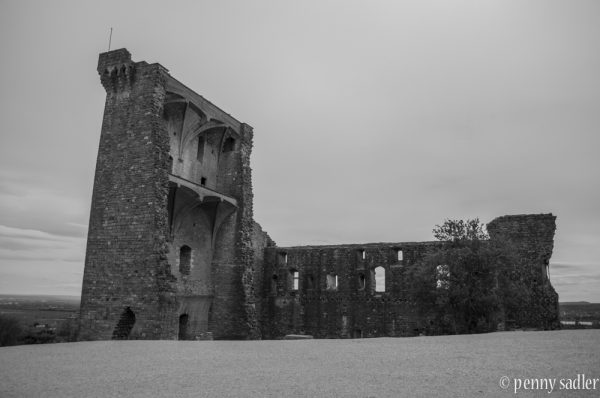
A ruined chateau built in the 14th century under the reign of Pope John XXII dominates the hilltop. To the west, the Rhone River meanders across the landscape.
Though only the south wall of the chateau remains, the view is breathtaking enough to warrant a visit to the ruins. Not to mention, there are ancient caves, wine, and food. But wait, I’m getting ahead of myself.

Most tourists travel to Chateauneuf du Pape to visit the many tasting rooms and vineyards. It is one of the most well-known appellations in the southern Rhone Valley and one of the world’s most popular wines. For wine enthusiasts and oenophiles, CDP is a must.
However, I think it would be a mistake to visit Chateauneuf for the wine alone. Of all the wine regions I’ve visited to date, there amongst the remains of the castle, you recognize what “a sense of place,” truly means.
History of Chateauneuf du Pape
The papacy moved to Avignon from Rome in 1309, and in 1316, Pope John XXII initiated construction of the castle. It was easy to see why Pope John chose this location with its 360- degree view of the village and vineyards below, only 30 kilometers from Avignon.
The popes of Avignon recognized that the land surrounding Avignon was perfect for producing top quality wine, in other words, wine that was better than what was already available. They planted new vineyards in the more fertile land to the north. Pope John is credited with improving viticulture in the area as well.
The Wine of the Popes of Avignon
The popes called their wine“vin du papes” (wine of the popes) and promoted it far and wide. If not for the popes, would the Chateauneuf du Pape be so well known? I think eventually, yes!
Pope John never spent much time at the chateau because he died a year of completion. None of the subsequent popes ever lived there either. Pope Clement VII used it as an occasional hideout. The castle was passed to the Bishop of Avignon but it was too expensive to maintain. In time, the stone was mined for building materials much like the Colosseum in Rome.
Grapes of Chateauneuf du Pape
Chateauneuf du Pape became one of the first AOCs or appellation d’origine controlée in France in 1936. What this means is that every step of the production of wine must adhere to strict standards. This is the same for every appellation in France.
Chateauneuf du Pape wines are unique because there are thirteen grape varieties allowed for the wine production. Most regions allow one or two grapes to be blended. For example, in order for Prosecco to be labeled Prosecco, the wine must be 85% Glera grapes.
Grenache is the backbone of Chateauneuf du Pape wines and the most widely grown of all the varieties. It lends the wine notes of dark cherry, blackberries and spiciness.
Chateauneuf du Pape enthusiasts claim the wines can be drunk young, and they are promoted so. In my opinion, they are more drinkable with a bit of age.
They also have a high alcohol content compared to other French appellations. In fact, CDP wines have the highest minimum alcohol content allowed, 12.5% but they are usually closer to 14%
Other important grapes in Chateauneuf du Pape are: Syrah, Mourvedré, Cinsault, Clairette, Vaccarése, Bourboulenc, Roussanne, Counoise, Muscardin, Picpoul, Picardin, Terret noir. Grenache Blanc and Grenache Noir.
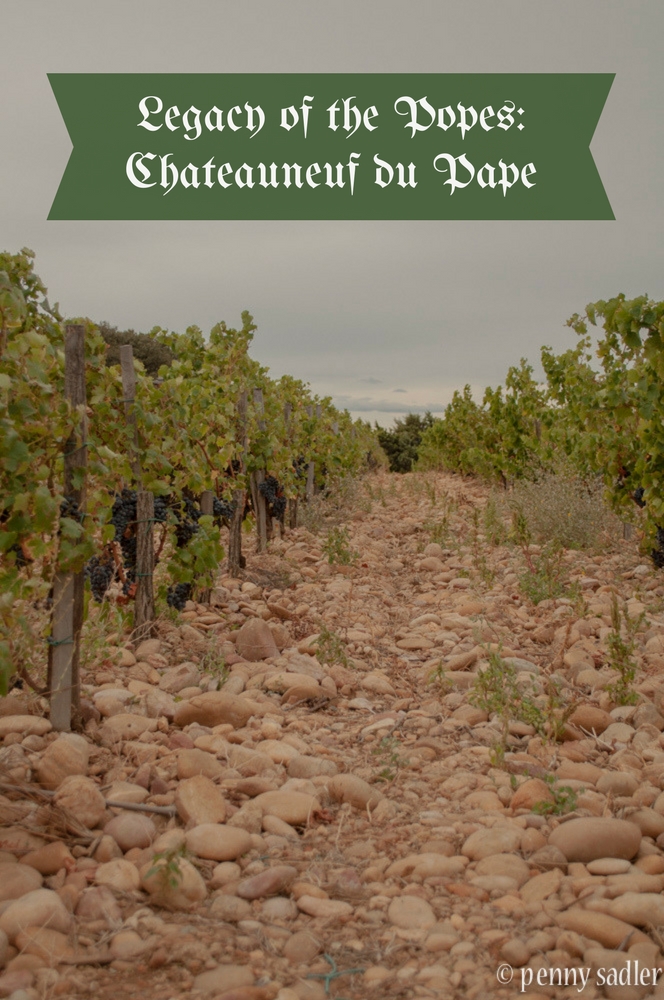
The climate is typically Mediterranean, very sunny and dry, thanks to the mistral wind. Biodynamic farming is much more easily accomplished here as pests simply do not thrive in this environment. There are many different soil types from clay to sand. The appellation is also characterized by the galets roulés – large round pebbles that help hold the heat in the soil and assist in drainage. Another feature of this AOC: All harvesting is accomplished by hand.
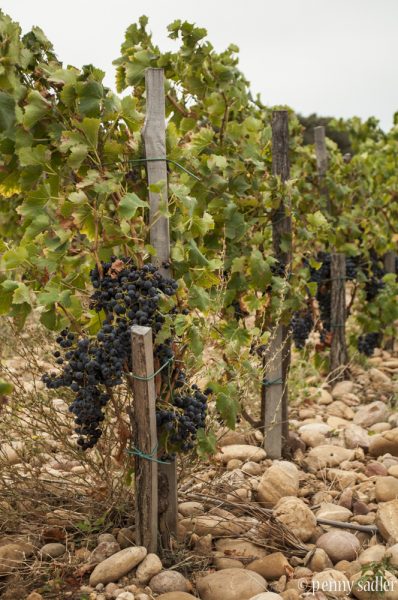
Notice the unique large round rocks that cover the top soil.
Wine and dining in Chateauneuf du Pape
After a brief walk around the ruins to take some photographs, Michael Ippolito, my guide, led the way to the Cave du Verger, a tasting room representing over 200 wines from the area. The limestone cave dated to Roman times.
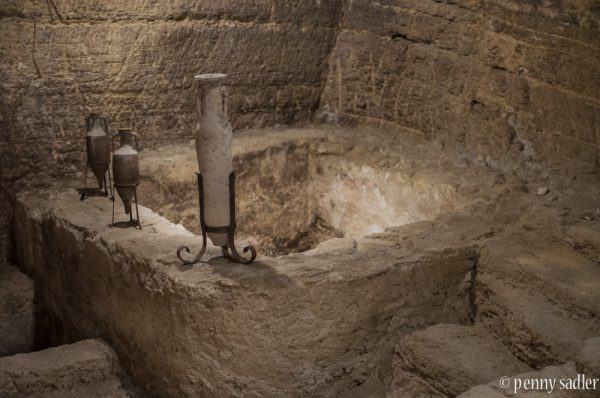
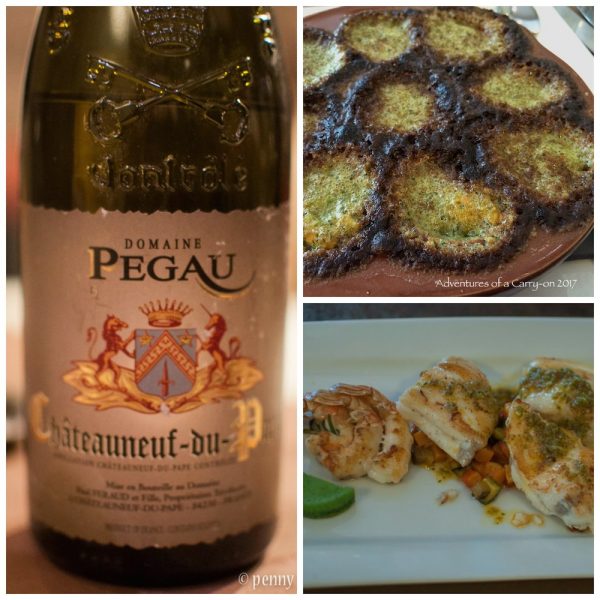
Michael had brought along a 2014 Domaine du Pegau a Tempo for us to drink, so we did not linger but went straight away to a private tasting room. The musty room, illuminated by candlelight, revealed bottles of very old vintages of Chateauneuf. The only other objects in the room were a table and chairs—yet I felt as though I were in a Michelin-starred establishment. A sommelier opened the wine for us and we toasted my first visit to France and Chateauneuf du Pape.
The wine was elegant with White flowers and citrus leading the way followed by a touch of stone fruits. Fresh and crisp, but with a long finish, this wine perfectly suited me. Give me an aromatic white wine and I’m happy.
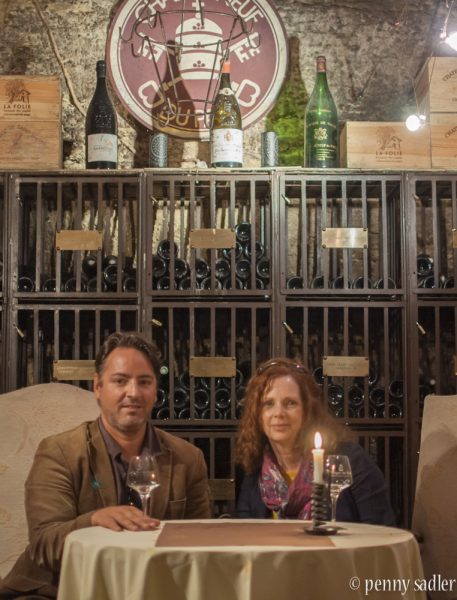
I was having a great time but things got even better…Michael had booked a reservation for lunch in the restaurant above the cave, Le Verger des Papes. Intimate, even though buzzing with French families enjoying a leisurely Sunday afternoon meal, Le Verger du Papes is a family-owned restaurant that appeared to be somewhat of a local secret. Afterwards we moved to the terrace for coffee, which shares the same stunning views of the Rhone Valley as the ruined old castle.
We started with mussels prepared in garlic and butter followed by duck breast with a red wine reduction. Michael had fish and shrimp in a light lemon sauce. Everything paired perfectly with the floral and citrus notes of the Domaine du Pegau.
We did not visit any other tasting rooms that day. As it was Sunday, most were closed. I had to return to Avignon to embark on a Rhône River cruise. Honestly, what could compare with the wine I drank in a 2000-year-old cave under the ancient chateau of the popes.
Thanks to Micheal Ippolito of Wine in Provence, for the fantastic Domain du Pegau and tour.




32 comments
This is one of my most favorite regions in France, which is saying a lot considering how much I adore the entire nation. There are so many amazing wines and territories to discover that my bucket list continues growing rather than shrinking!
I agree
[…] Sadler, P. (n.d.). LEGACY OF THE POPES: CHATEAUNEUF DU PAPE. Retrieved from Adventures of a Carry-On: https://www.adventuresofacarryon.com/legacy-popes-chateauneuf-du-pape/ […]
[…] Be sure to get the whole scoop on Penny’s visit to Chateauneuf du Pape on Adventures of a CarryOn! […]
Very interesting! I Would love to learn more about the history of château, thanks for sharing.
I really love wine so place with as many as 200 various kinds sounds like paradise! I am glad to read about your wine sating experience. In my country we say that where people drink wine, people live better.
Hello Veronika, I am not sure where you are from but I agree, wine does make life better.
I agree that visiting a wine region only for the wine is silly! So many wine regions are beautiful or have a lot of history. That castle looks like the perfect place to check out 🙂
Thanks Annie. It is and the Le Cave tasting room is excellent. You don’t have to do a tasting, just go check it out!
My wife and I drank a Chateauneuf du Pape blended red wine on our wedding night and for 24 years after that. I’ve always wanted to go yp Feance amd see the wineries on the Rhone.
What a nice tradition! I highly recommend visiting the Rhone Valley and especially while you’re in France, Provence. Let me know if I can help facilitate that! Best to you!
Chateauneuf du Pape is world famous and I am happy that thanks to your post this got on my radar again! And that I have some more knowledge on the wine history and region. It’s such a shame that the region is just a little to far for a weekend drive from Amsterdam!
How interesting to learn about this place and its history. I think its great how they can blend 14 different types of grapes into wine, since that actually might enhance the flavors. Sounds like it was a great experience!
Wine tasting in Chateauneuf du Pape is fabulous – I agree it is like drinking a bit of history! Excellent post 🙂
Hey Penny,
Thanks for the article. I’ve never been to Western Europe but places like this and posts like this make me really curious about European history and visiting. I’m not a hardcore wine person but it sounds like this place is worth the drinks! Appreciate your input.
Cheers,
This sounds like an amazing experience. I love when you’re able to be immersed in so much fascinating history while indulging in great food and drink!
Sounds like an amazing tour. It seems like there are more and more wine tours popping up but nothing compares to a wine tour in France repleat with castles. (Or at least chautiues)
It’s true. Castles and chateaux…
There is something so picturesque and cool about the wineries in France, I know. But I am a non- drinker so pointing out different things to see within wine country is great 🙂 Thanks
I’m glad to hear that because I love wine country travel – not only for the wine but the culture and history.
This is really strange, I explored that area way back in 2010 and never came or heard across the Chateauneuf du pape. Now I am going to try and find it when I drive through that region of France like I do often from north to south.
Very strange indeed.
Really happy to have crossed paths with this today, we were just discussing some similar options for a trip to the Rhone region. I’ve been a huge fan of Chateauneuf du Pape since being turned on to it in the early 90s by an early Guigal fan. He’s still among my favorite winemakers. Will pin for future reference.
Hey Bob, thanks for the comment. Happy to hear that it was helpful for you.
Chateauneuf du Pape certainly has the reputation of producing excellent wines! It must have been lovely to visit the area in person — and taste some of their vintages :-).
It’s a very interesting area for sure.
Oh wow, what an experience! And I would LOVE to visit the old wineries in France, something I didn’t do when I was there many years ago.
Well you must go back!
This is one of my absolute favourite regions of France, which is saying something because I love the entire country. There are so many incredible wines and domains to discover, my bucket list keeps getting bigger instead of smaller! 🙂
I know what you mean. There’s always more to explore!
I would love to visit the château … especially a a bottle of white CNP! You lucky lady!
it was fantastic. I wish I had another!