
When I look back on some of my more memorable experiences in Rome, the backdrop is always a piazza. Piazzas are the hubs of social life in Italy. Invitations don’t even need street addresses in the historic center of Rome, you only need the name of the cafe or bar, and the Roman piazza where it is located or at least near.
Cathedrals, fountains, and obelisks distinguish one piazza from the next. For example, you only have to say: Meet me by the Fountain of the Four Rivers, and most people will know you mean Piazza Navona. Large or small, ornate or not, the Italian piazza is a way of life.
If you’re traveling to the Eternal City, you will discover your favorite piazzas too. It’s a good idea to get to know the piazza closest to your hotel as that is likely where you’ll have a daily coffee or apertivo.
Have a read and take some notes because I’m sharing some of my favorite piazzas. You won’t need to worry about getting lost in Rome as long as you know the name of the piazza or a nearby church. There is no particular order to this list.
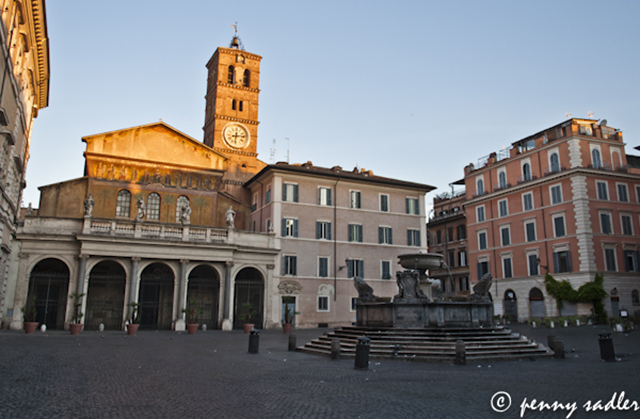
Piazza Santa Maria in Trastevere
The beautiful piazza and Basilica of Santa Maria in Trastevere is a premier people-watching spot—a crossroads where eventually, everyone meets. The fountain is lovely but you may not notice unless you are there early in the morning before people are lounging about…the fountain is a popular spot to sit and watch street performers, smoke a cigarette, or meet friends. There are also many good cafes where you can enjoy the spectacle from afar.
The Basilica
The first church in Rome dedicated to the Virgin Mary, Basilica Santa Maria in Trastevere is spectacular inside and out, with a Romanesque brick bell tower, and gold mosaics gleaming in the sun. It contains the crypts of several popes and is believed to have been founded around 300 -400. It was completely rebuilt in the 12th century by Pope Innocent II and incorporates materials salvaged from the Baths of Caracalla.
A legend says the church is believed to have been founded on the location where oil flowed from the ground on the day Jesus was born. There is a side street that honors the legend, Via delle Fonte dell’ Oglio.
Why go: Trastevere is one of the more popular neighborhoods in Rome, There are many good restaurants and bars in Trastevere. Bar San Calisto, an institution, is adjacent in Piazza San Calisto.

Since its beginning in the 1st century A.D., Piazza Navona has been a hot spot for culture and entertainment in the historic center of Rome. It is considered one of the prettiest piazzas in Rome because of the stunning fountains and beautiful baroque architecture.
The most famous fountain is Fontana dei Quattro Fiumi or Fountain of the Four Rivers by Bernini, built in front of the church St. Agnes in Agony.
On a tour with a guide for Ask a Local , I was told that Bernini positioned the figure of a cowering Rio de la Plata in the fountain, as if fearing the facade of the church of Sant’Agnese designed by his rival Borromini. However, the fountain was completed several years before Borromini began work on the church. This is a popular myth told by tour guides.
There are two other fountains, Fontana del Nettuno and Fontana del Moro (Fountain of Neptune and Fountain of the Moors) created by Giacomo della Porta, an apprentice of Michelangelo.
Thirty feet below the piazza are the ruins of the Stadium of Domitian. Up until the 15th century track and field events were hosted there and the occasional gladiator competitions.

Tourists enjoying a sunny day in Piazza Navona.
Coincidentally, the three fountains in Piazza Navona indicate that water is still an important feature. According to at least one guide I know during the 1600s through the 1800s, the stadium was often filled with water to stage naval battles and aquatic games. However, this seems to be disputed now. The piazza was occasionally and intentionally flooded but not for naval games it seems.
Above all, Piazza Navona is a great place for people watching, so spend a few euros for a ringside seat at one of the most entertaining shows on earth.
Why go: Because everyone goes to Piazza Navona…it’s the perfect see-and-be-seen place. You must also see Gian Lorenzo Bernini’s fountains.

Piazza San Pietro, Vatican City
Piazza San Pietro
St. Peter’s Square is the granddaddy of piazzas in Rome. A stunning design by Bernini, it’s composed of 284 columns of Roman travertine stone.
If you’re Catholic, St. Peter’s Basilica is likely why you came to Rome. One of the four major basilicas in Rome and the largest in the world, the basilica is a treasure trove of art, however two pieces stand out, the Pietá by Michelangelo, and the Baldachin by Bernini.
My first time in Rome I stayed at a B&B within five minutes walk to St. Peter’s and a pretty good view of the dome. The owner sold it shortly after I was there but I think this is the place. I stayed about a week and so had time to explore the basilica, the crypts, and the neighborhood.
St. Peter’s is in Vatican City along with the Vatican Museums. The tour I took spent a couple of hours studying the art and sculpture in the museum before reaching the Sistine Chapel.
If I were to go now I’d do this cool Pristine Sistine Chapel Tour with Walks of Italy. Or check out this private tour that includes the crypts and a dome climb. There are so many great tour options!
The Vatican includes lovey gardens to explore in addition to the many other reasons to visit. You should probably plan to spend at least a half day there. If you book the tour through my link I receive a small commission at no extra cost to you. Grazie!
Why go: No explanation needed.

View of Piazza del Popolo from Pincio Terrace
Piazza del Popolo
There are many reasons to go to Piazza del Popolo, aka, the People’s Piazza: art, the Pincio Terrace, the churches, and the spectacle are a few. One of the largest piazzas in Rome, Piazza del Popolo was the original entrance into the city.
Basilica Santa Maria del Popolo is a must for some of the best art in Rome — I’m talking Caravaggio, Bernini and Raphael. The basilica is on the north end near the Aurelian Wall. There are two other churches opposite Basilica Santa Maria del Popolo marking the so-called Tridente, three streets connecting the historic center of Rome to Piazza del Popolo. If you are a true art lover consider a walking tour that includes Caravaggio’s work at the chapels in Piazza del Popolo.
Architecturally, the obelisk in the center of the piazza is the Egyptian obelisk brought to Rome by Emperor Augustus in 10 BC. Think about that.
Another must, walk up to the Pinco Terrace for incredible views over the piazza and the historical center of Rome.
Why Go: The Porta del Popolo is the historic gateway and entrance to the city of Rome. Also, for all the other reason mentioned: art, obelisks, views, people watching.

Piazza Venezia
Piazza Venezia
I found myself passing through or by Piazza Venezia many times. Depending on where you stay and what you do in Rome, you too will likely become too familiar with it.
Piazza Venezia is the hub of the historic part of the city, adjacent to the Roman Forum; the Colosseum is a stone’s throw, and the Capitoline Hill and museums are there. It’s a wildly busy part of the city but there’s no avoiding it. Crossing the street here is challenging to say the least. Drivers seem to enjoy playing chicken with pedestrians. Be careful!
The white building sometimes referred to as the typewriter or the wedding cake, is the Victor Emanuel II monument. During the reign of Mussolini, it became a stage for Fascist military marches. Today there are no signs of this dark period in history.
Overlooking the piazza is the Palazzo Venezia and the Palazzo Assicurazione della Generale di Venice. The former, once occupied by Mussolini, is now a museum and the latter is a bank.
Why Go: There are so many reasons to go to Piazza Venezia. But if I only share one it would be to go during rush hour and watch the cop standing on a pedestal in the middle directing traffic!

View of the Forum from Capitoline Hill
Piazza del Campidoglio
Another creation of Michelangelo, Piazza del Campidoglio sits on Capitoline Hill, the most important of the seven hills of Rome. Michelangelo who believed the Capitoline Square should face St. Peter’s not the Roman Forum. I think Michelangelo made a good decision!
The piazza was commissioned by Pope Paul III to spruce up the Capitoline Hill before a scheduled visit by the Holy Roman Emperor, Charles V.
The Capitoline Museums are on each side and they are worth a visit. In the center of the square is a copy of an imposing statue of Marcus Aurelius. The original is inside the museum.
There’s a nice cafe here too which can be crowded during the lunch hour. I often sat with strangers because the tables were full.
The views over the rooftops toward the Jewish Ghetto from the museum terrace are excellent. On weekends there are always very lavish weddings here. I saw many and took some fun photos. It’s one of my favorite spots in Rome.

Capitoline Hill & Steps leading to Piazza Campidoglio
Why go: The best sunset views of the Roman Forum are from the back of this piazza. It’s also conveniently located by Piazza Venezia and the Colosseum. Allow a couple of hours to tour the museums.

Pre 2019, crowds would flock to sit on the Spanish Steps. No more.
Piazza di Spagna
This may be one of the most famous piazzas in Rome for a few reasons. Leading to the piazza are the beautiful Spanish Steps, a popular place to see and be seen. It used to be a place where people hung out — staking out a place to sit on the steps and eat lunch, make out, and people watch. But due to the out-of-control crowds and a recent restoration of the steps, that’s off the table. Things change. I remember standing on the steps watching a group of dancers circling he fountain (designed by Bernini’s father).
You may recognize the location from a scene in Roman Holiday with Audrey Hepburn and Gregory Peck. The church at the top of the steps is also worth visiting if you have time. And, if you haven’t seen Roman Holiday, read my article hyper-linked here.
Why go: There are great views towards St. Peter’s at the top of the steps. See the house where the English poet John Keats lived until his death. Also, some of the most expensive shopping in Rome can be found here.

Piazza Mattei
I would often pass by Piazza Mattei is in the Jewish ghetto when walking from Trastevere to Piazza Venezia. It’s a small square that for some reason always seems busy. The most interesting feature of the piazza is the Fountain of the Turtles aka Fontana delle Tartarughe, designed by Giacomo Della Porta and Taddeo Landini. Later, Bernini added the namesake turtles.
Why go: The fountain has a very Alice in Wonderland feel perhaps because of all the people who contributed to it and by the way, all of these men also contributed to Piazza San Pietro.

Piazza di Sant’Ignazio
I think Piazza Sant’Ignazio is one of the most unique piazzas in Rome. Designed by Filippo Raguzzini, a proponent of the Rococo style, it’s meant to resemble a stage with exits on either side.
There’s a gorgeous terra cotta-colored building on the piazza that is both residential and a police station. It’s a quiet and pretty piazza, between the Pantheon and Via del Corso. There is something about this piazza that is very elegant in an old-world style. This is a place you can enjoy without crowds.
The Church
The exterior of the church is Baroque and designed by architect Orazio Grassi. It holds no clues to the beauty of the interior, nor do these photographs do it justice. The church was built to honor Saint Ignatius of Loyola. It is a beautiful little church built in the 17th century. I passed it about a thousand times before I ever went inside. The interior ceiling frescoes, painted by Jesuit Andrea Pozzo in 1685, are a masterful optical illusion, creating a dome effect but the ceiling is flat!
Notices are often posted here about upcoming classical music concerts; if that’s your thing, keep your eyes open when you are in the area.
Why go: Go to see the faux vaulted ceiling and have a drink in the piazza.

Piazza Farnese
Piazza Farnese (plus 1)
I have great memories of sitting in a cafe on this piazza with an Aperol spritz and giving two Italian women an impromptu makeup lesson. Piazza Farnese is named for an important Roman family during the Renaissance period. Alessandro Farnese, who became Pope Paul III in 1534, commissioned the construction of Palazzo Farnese in 1517 and employed Michelangelo to help with some of the design.
Why go to Palazzo Farnese? Palazzo Farnese houses one of the finest fresco cycles, described as comparable only to the Sistine Chapel. The frescoes are in the Carracci Gallery and are described as blending the transition from Mannerism to Baroque. This is on my list of things to see the next time I am in Rome.
Why go: Piazza Farnese is a good place to escape the crowds in Rome. It seems like it’s a place for locals more than tourists.
This is not an exhaustive list of Rome’s piazzas…just a few I especially like and where I spent a lot of time. Some are incredibly important, like St. Peter’s Square, and others are quietly pretty like Piazza Mattei. Tell me, which is your favorite in the comments. Or send me an email!
If your travels are taking you to Venice, be sure to read my article about Piazza San Marco and one of the best squares in all of Italy. And if you are heading to the Lombary region of Italy check out Piazza del Duomo in the charming city of Voghera.
Where to stay near Rome’s best piazzas

Piazza Della Minerva




6 comments
Piazza del Popolo, like Piazza San Pietro, is in a different class, I think, from what I think of as a piazza. They are both so large that we should have another name for them. Megapiazzas? Yes, everybody needs to know about those Caravaggios in situ and so easy to see.
I agree with you. They are more than piazzas, they are monuments in and of themselves. I miss Rome. Thanks so much for your lovely comment. Sometimes virtual travel is the best travel. 😉
Your comment inspired me to track down my photos of Piazza Del Popolo.
My #1 is Piazza Navona, and my #2 is the Campigodlio. Your list is lovely, informed, well-judged, I think. Right now I miss being in every one of them. Thank you for taking me there however indirectly.
I’d like to add the Piazza del Popolo just a few steps from the Spanish Steps and you can visit Santa Maria del Popolo basilica (with Caravaggio paintings) and see one of the ancient roman city walls gates.
Hey Franco, great suggestion. I was thinking that I should add that one. Also, Piazza di Spagna.