I was prepared to love the wines of Alto Adige. The varieties produced in the region are some of my favorites: Gewürztraminer, Pinot Grigio, and Pinot Bianco. Since Alto Adige (Südtirol) in northern Italy is known for white wine, I was surprised that it was one of the red wines I sampled, the Schiava, that really won me over. A pale garnet-colored wine, it had an inviting aroma of juicy red fruits like pomegranate and strawberries, which I also tasted on the palate, along with very mild tannins.
The Schiava was one of eight wines featured at a professional masterclass on Alto Adige wine and food at Eataly in Dallas, Texas. Led by Melissa Monosoff, MS, the seminar was geared toward wine writers and industry pros, but the core lesson was simple: the flavors of Alto Adige are approachable, incredibly high in quality, and ripe for a new audience of travelers and wine enthusiasts of all levels.
Where Is Alto Adige? Italy’s Alpine Wine Region
Alto Adige borders both Austria and Switzerland. The shared border also means shared culture, food, and language. The Alps shelter the region from the north while warm air flows up the Adige Valley from Lake Garda. With 300 days of sunshine and that warm southern air, you’d never guess you were in the Italian Alps. In Merano, you’ll even see palm trees.
The backbone of this wine region are its cooperatives, which produce some of its most acclaimed wines. Internationally renowned wine critic James Suckling has followed Alto Adige’s wines for more than 40 years, and in 2025 the region’s wine consortium honored him with a special Wine Culture Award.
The Cooperatives Behind the Wines
Cantina Bozen is a marriage of two cooperatives forming one co-op of 224 member-growers, committed to sustainable agriculture and to traditional varieties such as Schiava and Lagrein.
Cantina Kurtatsch is a [size to confirm with the consortium] cooperative committed to producing sustainable, characterful wines, “vineyard by vineyard, wine by wine.”
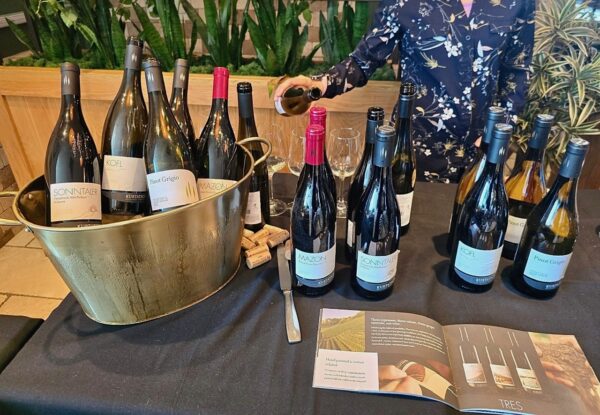
8 Alto Adige wines to know
While Alto Adige is still under the radar for most Americans, the grape varieties grown there are a mix of the familiar and the less familiar.
Familiar Grapes with Alpine character
Cantina Bozen Pinot Bianco (PEE-noh bee-AHN-koh) Pinot Bianco was once Alto Adige’s signature white: in 1978 it covered most of the region’s white-grape acreage. It’s crisp and fresh, with gentle fruit. This one is made in stainless steel, with no oak, allowing the fruit to shine. Try it if you like: unoaked Chardonnay. Pour it with: speck, mild cheeses, or a light first course.
Cantina Kurtatsch Pinot Grigio (PEE-noh GREE-joh) Today Pinot Grigio is the region’s most widely planted white, and Alto Adige’s mountain versions have more depth and freshness than the mass-market bottles most Americans know. To me it was less aromatic than Pinot Grigio from other regions, yet on the palate I tasted citrus and ripe fruits. Try it if you like: Pinot Grigio and want to try something different. Pour it with: a young, creamy cheese or as an aperitif.
Cantina Kurtatsch Kofl Sauvignon In Alto Adige, Sauvignon Blanc is simply called Sauvignon. This one comes from the 2020 vintage, giving it a few extra years of development compared to the others. The herbal notes stood out to me. On the palate it was crisp and medium-bodied, and it paired well with the fresh green salad served at lunch. Try it if you like:Sauvignon Blanc, but find some versions too sharp. Pour it with: a fresh green salad, herb-driven dishes, or fresh goat cheese.
Cantina Kurtatsch Pinot Nero Riserva Mazon (PEE-noh NAIR-oh) Pinot Grigio and Pinot Bianco are both mutations of Pinot Nero (Pinot Noir), which makes this the head of the family. Mazon is a small plateau widely considered one of Italy’s best sites for Pinot Nero. I liked this expression of Pinot Nero. It smelled of cigar boxes and ripe cherries, and the tannins were well integrated. Try it if you like: Pinot Noir or red Burgundy. Pour it with: the aged Alta Badia cheese or roasted meats.
Varieities from North of the Alps
Cantina Bozen Müller-Thurgau Eisacktaler (MEW-ler TOOR-gow) Named for Swiss botanist Hermann Müller, from the canton of Thurgau, who created the grape in the 1880s. This one comes from the Eisacktal (Valle Isarco), one of Italy’s northernmost wine valleys, known for its fresh, aromatic whites. This one was lovely: very floral and light on its feet, which makes it an excellent food wine. Vineyards at high altitude, like those in the Eisacktal, give the grape bright, crisp acidity to balance its perfume. Try it if you like: light, floral whites. Pour it with: an aperitivo spread, or on its own.
Cantina Bozen Kerner Puntscheit (KAIR-ner) Kerner is named after a German poet, and it has a family secret: it’s a cross of Riesling and Trollinger, better known in Alto Adige as Schiava. This one spent time resting on its lees (the spent yeast left after fermentation), which gives the wine extra richness. It smelled of mountain flowers and peach, and was full-bodied and dry, with fresh acidity. Try it if you like: Riesling. Pour it with: speck and Alpine cheeses, or Knödel.
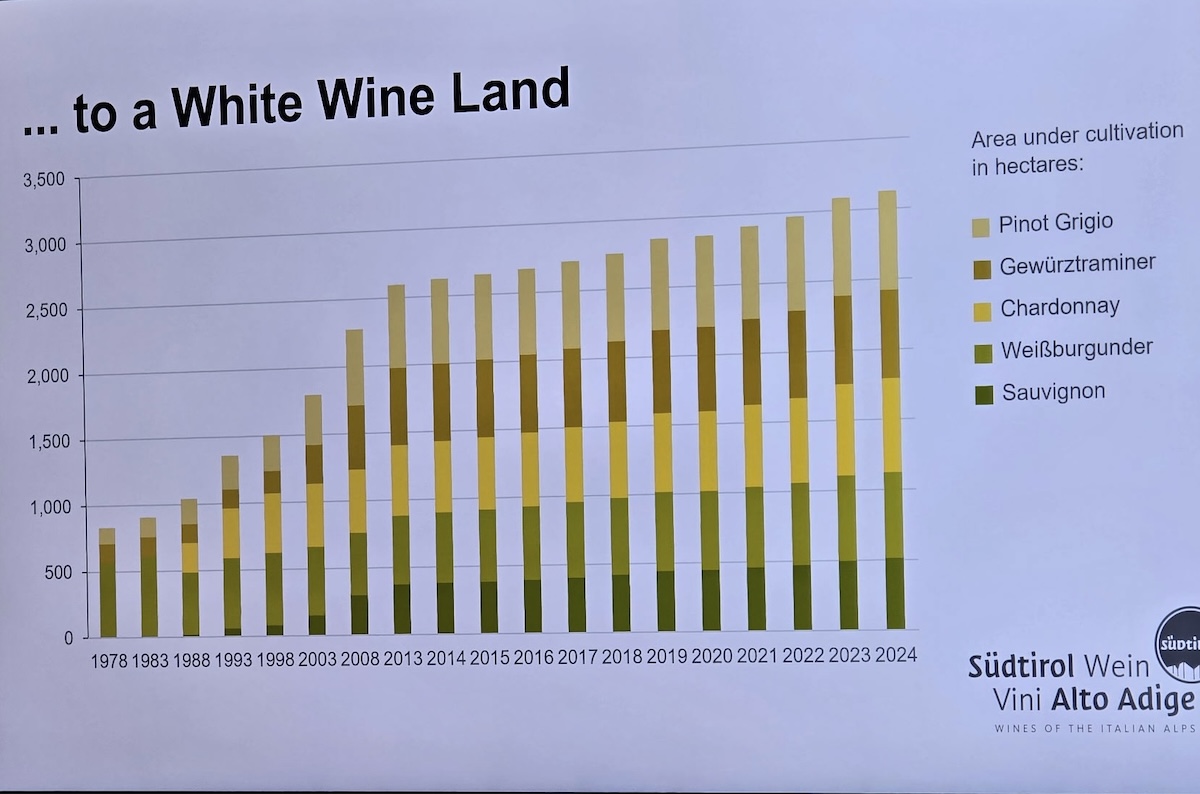
Pinot Grigio is the #1 grown white wine grape.
Indigenous varieties: Schiava and Lagrein
Cantina Bozen St. Magdalener Classico Huck am Bach (sankt mahg-dah-LAY-ner) St. Magdalener is a red made mostly from Schiava with a splash of the local Lagrein, grown on the hills around Bolzano. “Classico” means it comes from the original, historic growing area. Aromas of dark red fruit gave way to light cherry on the palate, with low tannins and good acidity. Try it if you like: lighter reds such as Pinot Noir or Beaujolais. Pour it with: speck and gnocchi; serve slightly chilled.
Cantina Kurtatsch Schiava (skee-AH-vah) The wine that won me over: pale garnet, with pomegranate and strawberry on the nose and palate, and very mild tannins. Schiava is a true local grape, rarely found outside the region. [Anything more you’d like to add.] Try it if you like: Pinot Noir or Beaujolais. Pour it with: speck and the aged Alta Badia cheese; serve slightly chilled.
The Food of Alto Adige: Speck, Knödel, and Alpine cheese
After learning about the wines, we were treated to a light lunch of traditional dishes: gnocchi with speck, and bread dumplings (Knödel in German), plus a board of sliced speck from the family-owned producer Recla and four cheeses from the dairy cooperative Mila. All of the wines we sampled were available to drink along with the food, perfectly illustrating the “what grows together goes together” philosophy.
What Is Speck?
I’d had speck before, but this time I was more aware of the difference between speck and other Italian cured meats. Speck is similar to prosciutto but it is leaner and lightly smoked during the aging process. The taste was more delicate than prosciutto, drier, less fatty, and less salty. It paired well with all of the wines I tasted.
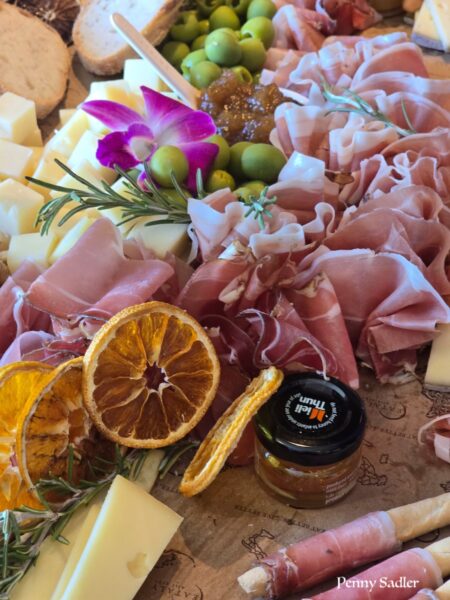
Alpine Cheeses from South Tyrol
Alpine cheeses are some of my favorites, but this was my first time tasting cheeses from this region. Most of the farms are over 3,200 feet above sea level, meaning the cows naturally graze on fresh mountain grasses in the spring and summer.
Aging ranged from 45 to 180 days, so we could taste both a young, fresh cheese with a creamier texture and an older, aged cheese. I especially liked the Alta Badia cheese aged 180 days. It had a firm texture and finished with a hint of almond, pairing well with red wines like the Schiava.
Good to know: All of the cheeses we tried were made with pasteurized milk and are vegetarian-friendly since they are produced with microbial rennet.
Why Alto Adige Deserves a place at your table
I’ve often said that travel led me to seek a WSET wine education, but it also happens in reverse: wine has motivated me to travel to a particular region. That’s exactly what this tasting did. My next destination is Alto Adige, with its cool-climate mountain wines, its mix of German and Italian culture, and its Alpine climate warmed by air drifting up from Lake Garda, all beneath the Dolomites, a UNESCO World Heritage Site.
Alto Adige FAQ
What does Alto Adige mean?
Alto Adige means “Upper Adige” in Italian. The region is named for the Adige River, and it covers the river’s upper, northern stretch, high in the Alps.
Is Alto Adige the same as South Tyrol?
Yes. Alto Adige is the Italian name, Südtirol the German name, and South Tyrol the English one. The region was part of Austria until after World War I, which is why it has both names and a blend of Austrian and Italian culture.
What is Alto Adige known for?
Crisp white wines such as Pinot Grigio, Pinot Bianco, and Gewürztraminer, along with local reds like Schiava and Lagrein. It’s also known for speck, Alpine cheeses, apples, and the dramatic Dolomite mountains, a favorite for hiking and skiing.
Do people speak Italian in Alto Adige?
Yes, Italian and German are both official languages, and signs are bilingual. Most residents speak German as their first language, but Italian is widely spoken, and in a few valleys you’ll also hear Ladin, an ancient local language.
Where to Find Alto Adige Wine and Food
This class was hosted by the Alto Adige Consortium at Eataly in Dallas, Texas.